FCPS Part 1 Pathology — Infectious Disease Pathology MCQs
Practice 22 Infectious Disease Pathology past-paper MCQs for FCPS Part 1 Pathology, each with a detailed explanation and reference. Try free samples below, then start a full quiz.
Part of the full FCPS Part 1 Pathology QBank — 3,808 questions across all subjects.
Infectious Disease Pathology is a core part of the FCPS Part 1 Pathology syllabus. HighYield's Infectious Disease Pathology question bank collects 22MCQs modelled on real past papers, so you practise the exact style and difficulty you'll face on exam day. Every question comes with a worked explanation and a subject reference, so you learn why an answer is right — not just which option to pick.
Work through Infectious Disease Pathology in Tutor mode to learn as you go, or switch to Timed mode to simulate real exam pressure. Your accuracy is tracked per subject, so you always know whether Infectious Disease Pathology is a strength to maintain or a weak area to drill.
Sample Infectious Disease Pathology Questions
The photograph shows a leukocyte abnormality in a 3-year-old boy, who has recurrent Staphylococcus aureus infections. Specialized studies show bactericidal and chemotaxis defects. What is the most likely diagnosis?
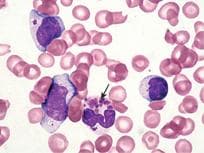
- A.Chediak-Higashi syndrome (CHS)
- B.Chronic granulomatous disease (CGD) of childhood
- C.I cell disease
- D.Job syndrome
- E.Myeloperoxidase deficiency
The photograph shows the retina of this patient. Which of the following pathogens is the most likely causal agent?
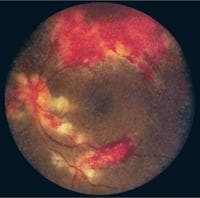
- A.Candida albicans
- B.Cytomegalovirus (CMV)
- C.Herpes simplex virus type 1
- D.HIV
- E.Toxoplasma gondii
A 23-year-old man complains of a recurrent rash on the shaft of his penis (see photograph). He states that the rash began as an uncomfortable burning sensation. Which of the following histologic changes is most likely present in a Tzanck preparation?
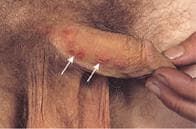
- A.Metaplastic squamous cells containing reticulate bodies
- B.Multinucleated squamous cells with eosinophilic intranuclear inclusions
- C.Squamous cells with basophilic intranuclear inclusions
- D.Squamous cells with increased mitoses and hyperchromatic nuclei
- E.Squamous cells with pyknotic nuclei surrounded by a clear space
Sign in to see the correct answers and detailed explanations for every question.
Ready to master Infectious Disease Pathology?
Start with 20 free questions — no card required.
Start free trial